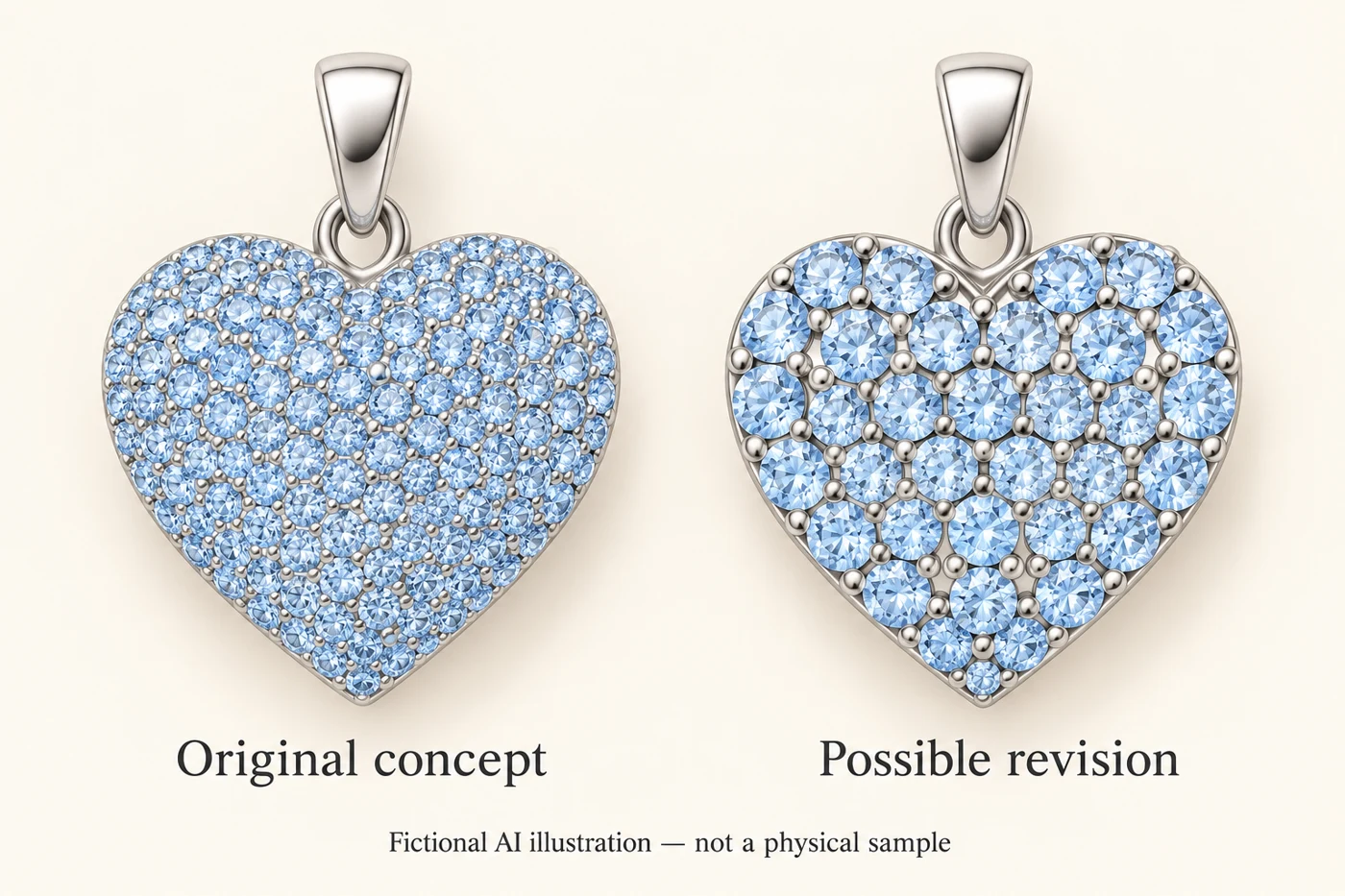
Yes, many AI-generated concepts can become real products — but rarely by treating the image as a finished production drawing. Our job is to protect the idea while translating impossible detail, unsupported structures and unrealistic surfaces into a repeatable jewelry process.
An image can look perfect at screen scale while containing geometry that cannot be cast, machined, polished, plated or stone-set consistently. A manufacturable design must survive both production and everyday handling.
AI often draws lines thinner than a stable metal feature or polishing-safe surface can support.
Elements may appear suspended with no bridge, wall thickness or mechanical support.
Rendered stones can be packed without enough metal for seats, prongs, drilling or secure setting.
A tool, mold, polishing media or plating solution may not reproduce/reach every digital crevice uniformly.
AI loves infinitely sharp transitions. Wearable jewelry needs safe edges and enough material for finishing.
A beautiful concave area may be impossible to polish consistently after forming or assembly.
A one-off prototype and a scalable commercial order are different engineering problems. We review the same concept through appearance, structure, tooling, finishing, plating, assembly, quality control and reorder consistency.
The table below is deliberately relative. Final MOQ and production timing depend on dimensions, tooling, construction, finish and order quantity, so we confirm actual numbers only after reviewing the design.
| Process | Best for | Detail / limitation | MOQ tendency | Lead-time tendency | Relative cost | Typical visual result |
|---|---|---|---|---|---|---|
| Stamping / forming | Flat or formed repeat parts, simple profiles, volume programs | Excellent repeatability; geometry must suit dies/forming | Lower at scale | Tooling first, then efficient | $–$$ | Clean, consistent, production-oriented |
| Laser cutting / engraving | Flat profiles, logos, line work, personalization, surface details | Great for controlled 2D detail; does not create every deep 3D form | Flexible | Shorter for suitable designs | $–$$ | Crisp lines / controlled texture |
| CNC machining | Geometric precision, heavier sections, technical components | Tool access and machining time matter; tiny inaccessible internal detail remains limited | Flexible to medium | Medium | $$–$$$ | Sharp, precise, engineered |
| Investment casting | Organic 3D forms, sculptural shapes, complex volume | Needs manufacturable wall thickness, feed/finish planning; very fine digital textures may soften | Project dependent | Medium / longer development | $$–$$$ | 3D, sculptural, organic |
| Assembly / mixed process | Complex concepts combining parts, stones, chains or cords | More joints and QC points; engineering must control tolerance stack-up | Project dependent | Often longer | $$–$$$ | More visual freedom |
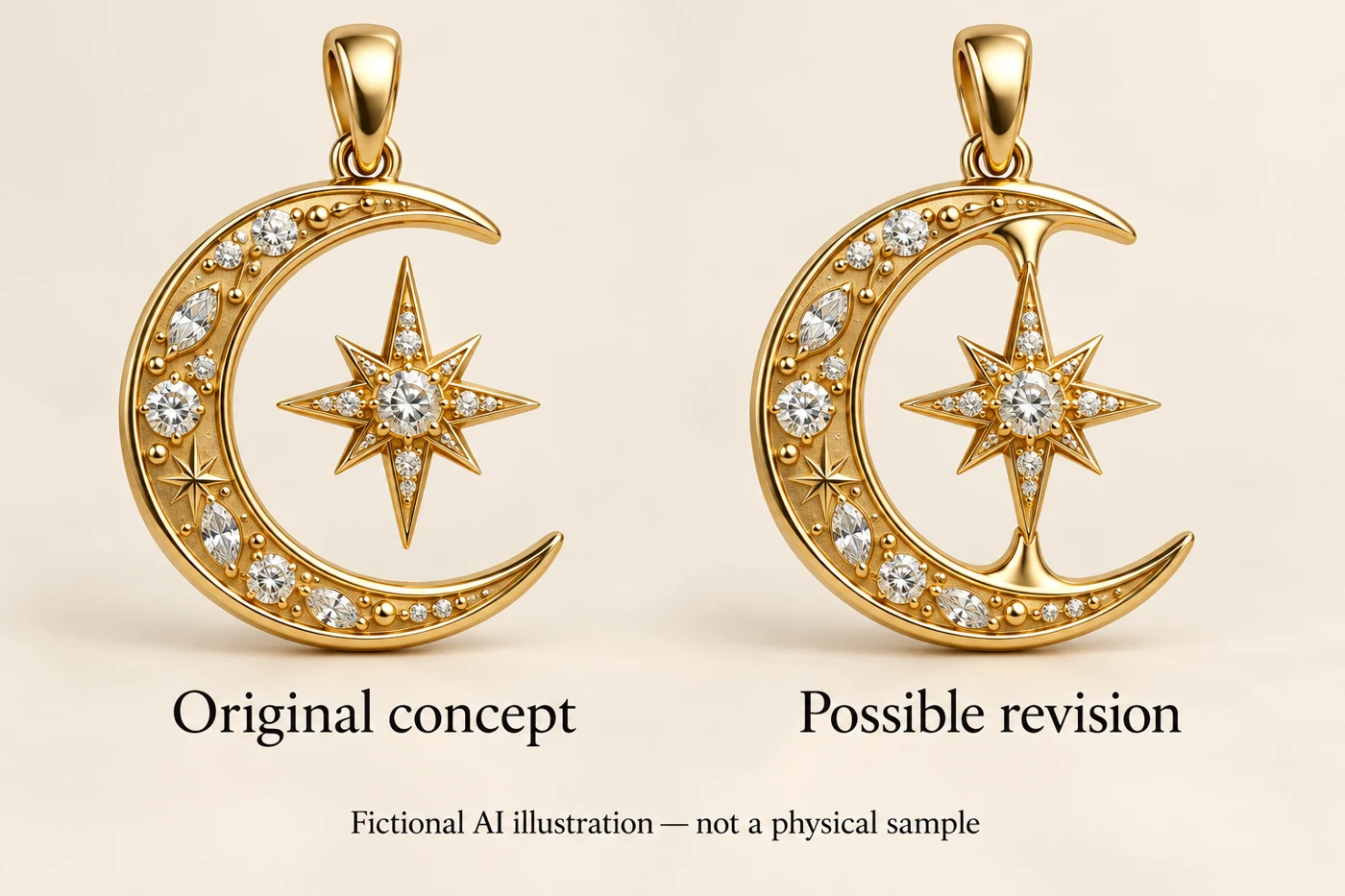
Relative indications only — not a quotation. Tooling investment can make a higher-volume process economical at scale, while a low-tooling process can be better for testing a design. Material choice also affects MOQ; see our 304 vs 316/316L guide.
AI image, reference, dimensions, target market and estimated quantity.
We identify impossible or high-risk details and propose production-safe alternatives.
We match construction, material and finishing to the commercial goal before sampling.
Confirm the physical result/specification, then move toward repeatable bulk production.
Send the original idea. We’ll show you which details are feasible and how to translate the rest without losing the design language.