Jewelry Testing & Compliance Reports
Understand what a jewelry test report can—and cannot—prove. A practical guide to project-specific testing, customer confidentiality, market requirements, and commercially realistic decisions for stainless steel jewelry.
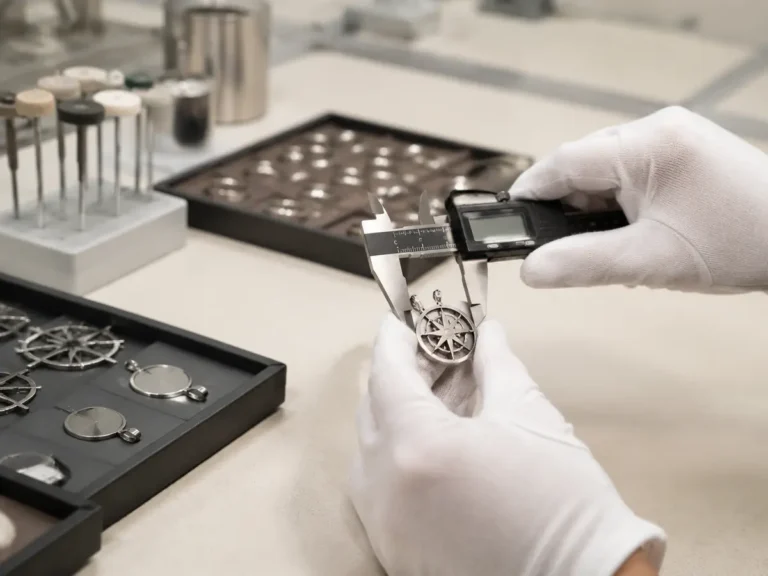
- Project-specific testing
- No sharing of confidential customer reports
- Market-appropriate evidence
- Clear testing cost planning
Why doesn’t every jewelry product have an existing test report?
A laboratory report applies to the specific sample and test scope that were submitted. Ready-stock jewelry is not automatically tested style by style before a buyer defines a destination market and evidence requirement. Testing can be arranged when the project, finish, market, and commercial budget justify the scope.
Can you provide a test report from another customer?
No. A report prepared for another customer may include confidential design, buyer, production, and sourcing information. We do not share customer-owned production documents without that customer’s authorization. Removing a customer’s name does not make an unrelated report valid for a different product, finish, or order.
Why can’t one jewelry test report cover every product?
A test result is evidence for what a laboratory actually received and examined. A different alloy, component, surface finish, plating color, manufacturing route, production batch, or destination market can change which evidence is relevant. Similar-looking jewelry is not automatically covered by the same report.
REPORT FACTOR
WHAT MAY CHANGE
WHY IT AFFECTS EVIDENCE
Base material
304, 316L, brass components, mixed alloys
Composition and exposure may differ
Surface finish
Real-gold PVD, plating color, coating system
The finished surface changes the test scope
Components
Clasps, earring posts, stones, solder
Each relevant part can require review
Batch & market
Production lot, destination, product use
Requirements and applicable evidence vary
What types of jewelry testing may be considered?
The appropriate laboratory scope depends on the finished product and target market. Buyers may consider nickel-release testing for skin-contact articles, lead or cadmium screening where applicable, material or alloy verification, coating or real-gold PVD specifications, and project-specific wear or performance evaluation. A laboratory or qualified compliance adviser should confirm the relevant standard and method.
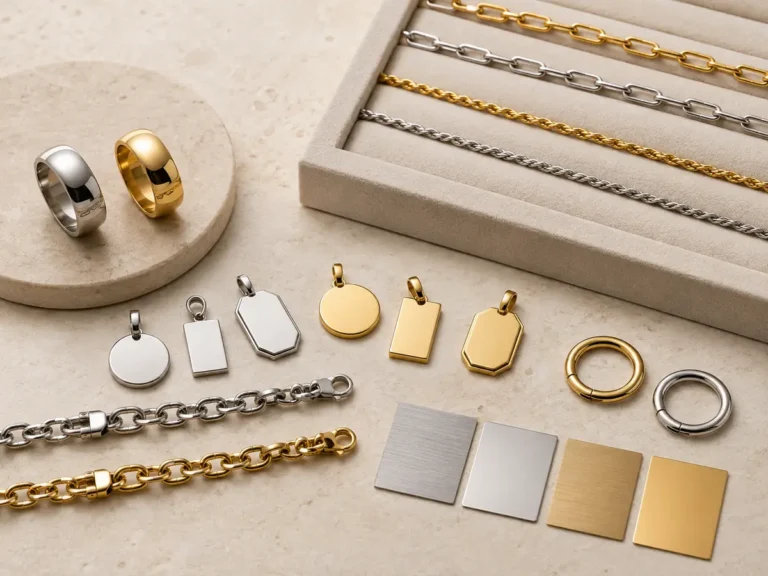
Does 304 or 316L stainless steel automatically mean a product is compliant?
No. A stainless-steel grade identifies an alloy family; it does not replace evaluation of the finished jewelry article. Components, welds, skin contact, real-gold PVD coating, and destination-market rules can all affect the appropriate evidence. We can specify real-gold PVD vacuum plating, with a typical production coating thickness of 0.03–0.06 μm depending on design and requirements.
Is jewelry testing necessary for small orders?
A small order does not remove the buyer’s legal or market obligations. The practical question is whether a specific third-party test is proportionate to the product, destination, and order value. For some cutting-based designs, production may begin around 100 pieces; a dedicated laboratory program can represent a significant additional project cost. We recommend confirming the real requirement before commissioning unnecessary tests.
Who pays for jewelry testing?
Third-party testing is normally an additional project-specific cost. The final arrangement depends on the buyer’s requirements, laboratory quotation, sample preparation, number of styles, and the commercial agreement. We do not promise a free existing report for every ready-stock item, and we do not present another customer’s private report as evidence for a new buyer.
MOQ depends on the manufacturing process—not one universal number
The right testing budget should be considered alongside production quantity. CHARMOND reviews each design with engineering before confirming the feasible process and final minimum order quantity.
100 pcs
Cutting-based designs start from 100 pieces, subject to engineering review of the design.
200–300 pcs
Casting designs typically require 200–300 pieces, depending on the style and engineering review.
600 pcs+
Hydraulic-press designs start from 600 pieces, subject to engineering review of the design.
How we arrange project-specific jewelry testing
The practical goal is to agree on evidence that matches the buyer’s actual design and market, without confusing ordinary production quality control with an independent laboratory compliance report.
01 · Share your design
Provide the jewelry style, materials, finish, components, and expected quantity.
02 · Confirm the market
Tell us where the product will be sold and how it will contact the wearer.
03 · Define the evidence
Identify the buyer, retailer, platform, or regulatory requirement that must be met.
04 · Review scope & cost
Assess sample needs, laboratory methods, timing, and the projected testing charge.
05 · Arrange agreed testing
Proceed with the relevant product-specific test only after the scope and cost are agreed.
06 · Protect confidentiality
Keep customer documents private and use the report only for the relevant approved project.
What we can—and cannot—promise
What we can promise
Review the design and destination market; discuss suitable materials and real-gold PVD; coordinate agreed project-specific testing; explain expected laboratory costs; respect customer confidentiality.
What we cannot promise
A ready-made report for every stock item; unauthorized copies of another customer’s documents; one report that automatically covers every style; unsupported “nickel-free,” “REACH certified,” or permanent-wear claims.
Jewelry testing & compliance report FAQ
Do you have an existing test report for every jewelry design?
Can you send me another customer’s REACH or nickel test report?
Can a report for a similar-looking product cover my order?
Can you remove another buyer’s name and send the report?
Does 316L stainless steel mean nickel-free?
Can CHARMOND arrange testing for a custom jewelry project?
Does a small order mean testing is unnecessary?
Can one test cover multiple jewelry styles or plating colors?
Will every shipment automatically include a laboratory report?
What information should I provide to discuss testing?
Who pays for third-party laboratory testing?
What if I am not sure which jewelry test I need?
Do you have an existing test report for every jewelry design?
No. Ready-stock styles are not automatically tested one by one. Testing is arranged when a defined product, target market, and buyer requirement justify the project scope.
Can you send me another customer’s REACH or nickel test report?
No. Reports prepared for other customers are confidential and cannot be shared without authorization. They also do not automatically prove that your own product or batch is compliant.
Can a report for a similar-looking product cover my order?
Not automatically. Different alloys, clasps, posts, PVD colors, surface treatments, production batches, and intended markets can change the relevant test scope.
Can you remove another buyer’s name and send the report?
No. Redacting a name does not change document ownership, confidentiality, or whether the tested sample matches your project.
Does 316L stainless steel mean nickel-free?
No. Stainless-steel grade is not the same as a nickel-free claim or a finished-product nickel-release result. Relevant exposure must be assessed for the actual article and market.
Can CHARMOND arrange testing for a custom jewelry project?
Yes, subject to agreeing the design, target market, laboratory scope, sample requirements, timing, cost, and commercial responsibilities.
Does a small order mean testing is unnecessary?
No. Destination-market obligations still apply. However, third-party testing should be planned commercially because its cost can be significant for small orders.
Can one test cover multiple jewelry styles or plating colors?
Only if the chosen laboratory and applicable requirements support the proposed grouping. Similar appearance alone is not enough to establish valid coverage.
Will every shipment automatically include a laboratory report?
No. Report delivery must be agreed as part of the specific project and corresponding testing plan.
What information should I provide to discuss testing?
Share product images or drawings, materials, components, finish, destination market, expected quantity, and any retailer, platform, or laboratory requirements.
Who pays for third-party laboratory testing?
The cost is reviewed and agreed as part of the project. It depends on the laboratory, number of samples, scope, methods, and production timing.
What if I am not sure which jewelry test I need?
Tell us where and how the product will be sold. We can help frame the production questions, while the appropriate laboratory or qualified compliance adviser confirms the formal test scope.
Need a report for your target market?
Send us your jewelry design, target country, material, finish, order quantity, and the document or standard your buyer actually requires. We will discuss a practical project-specific path before sampling or production. Email: miabai@charmondjewelry.com
Related jewelry manufacturing guides
CHARMOND is the brand of Shenzhen Juezhimeng Jewelry Co., Ltd., established in 2025 and building on a jewelry manufacturing operation that began in 2012 in Chang’an, Dongguan, China.