Manufacturing process guide

Choose the jewelry manufacturing process that fits your design.

Cutting, casting and hydraulic pressing solve different design problems. Compare shape, tooling, finish and confirmed process-based MOQ before committing to samples or production.

CUTTING-BASED DESIGNS100 pcs+Reference starting quantity. Final MOQ depends on size, material use, finish and design details.
CASTING200–300 pcsTypical reference range, depending on the style, mold route and production requirements.
HYDRAULIC PRESSING600 pcs+Reference starting quantity for projects that justify dedicated forming tooling and repeat volume.
The practical starting point

Process follows geometry—not just appearance.

Two pieces can look similar in a rendering but require different manufacturing routes. Engineers review profile, thickness, depth, undercuts, stone setting, edge treatment, polishing access and expected quantity before recommending a process.

These MOQ figures are planning references, not universal promises. The final route and minimum quantity are confirmed after CHARMOND reviews the actual drawing, dimensions, material, finish and order plan.
Side-by-side comparison

Cutting vs casting vs hydraulic pressing

FactorCuttingCastingHydraulic pressing
Typical design fitFlat or layered forms, letters, tags, geometric outlines, openwork and sheet-based components.Curved, dimensional and three-dimensional shapes; integrated details and complex contours.Repeat formed profiles, shells and stable shapes that can be produced consistently with a dedicated die.
Reference MOQ100 pcs+200–300 pcs, depending on style600 pcs+
Tooling logicOften less dependent on a complex mold, but fixtures and secondary operations may still be needed.Usually requires a mold or casting setup appropriate to the item.Requires forming dies or tooling, making stable volume important.
Design depthBest for controlled sheet thickness and limited three-dimensional depth.Useful when volume, curvature or undercuts cannot be achieved by simple cutting.Useful for repeatable formed depth within the limits of material flow and die design.
Key finishing concernsCut edges, burr removal, corner radius, openwork stability and polishing access.Surface cleanup, porosity control, parting areas, polishing access and dimensional consistency.Springback, edge condition, formed dimensions, die marks and consistency between runs.
Best commercial useLower-volume custom launches with suitable flat geometry.Dimensional brand collections and styles needing more sculptural freedom.Higher-volume repeat programs with stable product geometry.
Three manufacturing routes

Where each process is strongest

01

Cutting

Laser or other cutting routes start from sheet or a compatible profile. The design still requires edge finishing, forming, welding, polishing or assembly as applicable.

  • Good for tags, initials and geometric outlines
  • Supports openwork when bridges remain manufacturable
  • Edge quality and polishing access must be planned
Reference MOQ: 100 pcs+
02

Casting

Casting is considered when the form is too dimensional for a sheet-based route. Mold strategy, cleanup and finishing have a direct effect on feasibility and cost.

  • Good for curved and sculptural shapes
  • Can integrate details that are difficult to form separately
  • Final MOQ varies with style and setup
Reference MOQ: 200–300 pcs
03

Hydraulic pressing

Hydraulic pressing uses dedicated tooling to form repeatable shapes. It becomes more practical when the design is stable and the planned volume supports the tooling route.

  • Good for repeat formed profiles
  • Requires consideration of material flow and springback
  • Best evaluated as a repeat production program
Reference MOQ: 600 pcs+
Jewelry fine lines and openwork design comparison
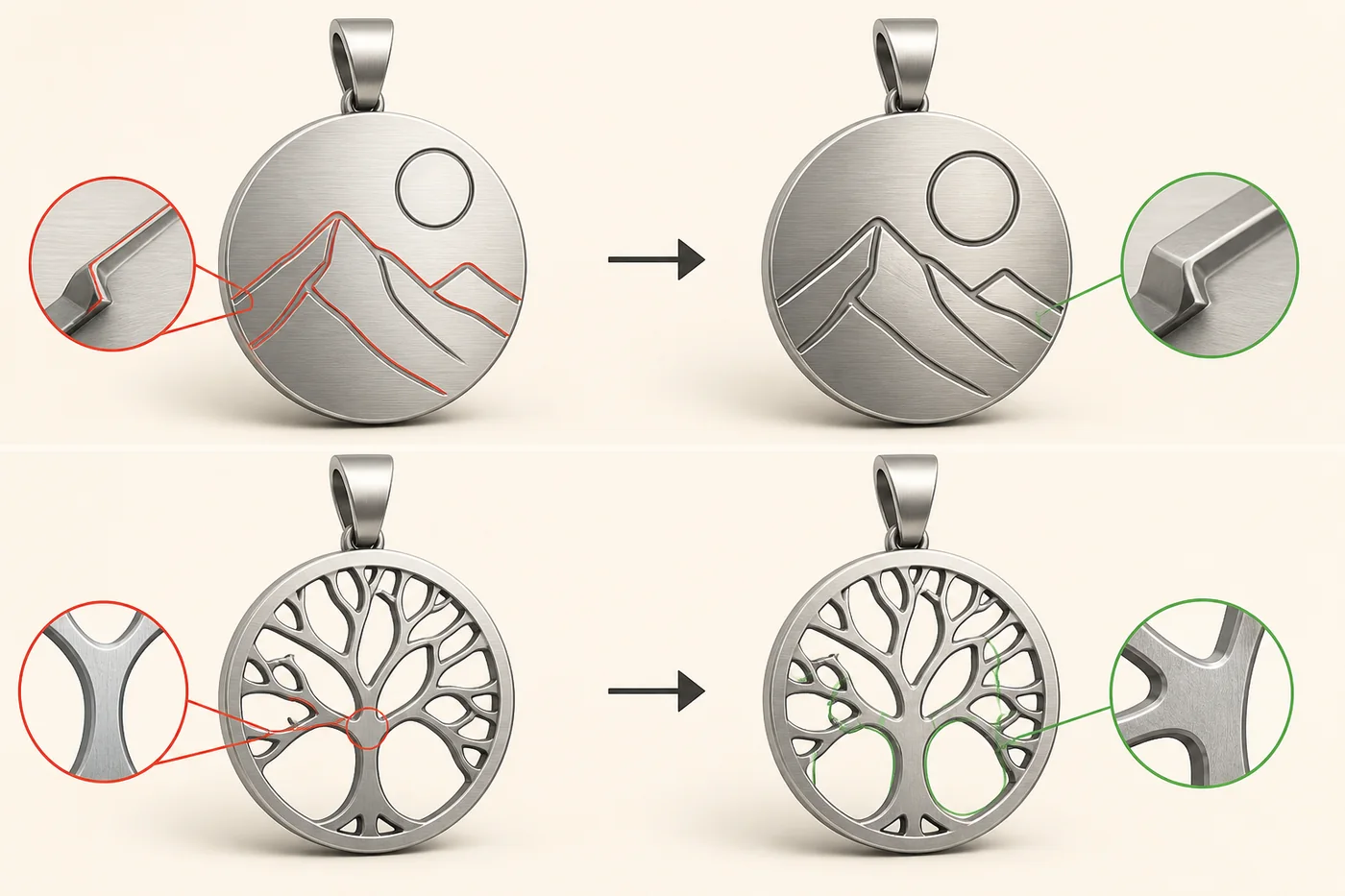
Fine lines and openwork need enough material around gaps, corners and connection points to survive cutting, polishing and everyday handling.
Jewelry grooves edges and polishing comparison
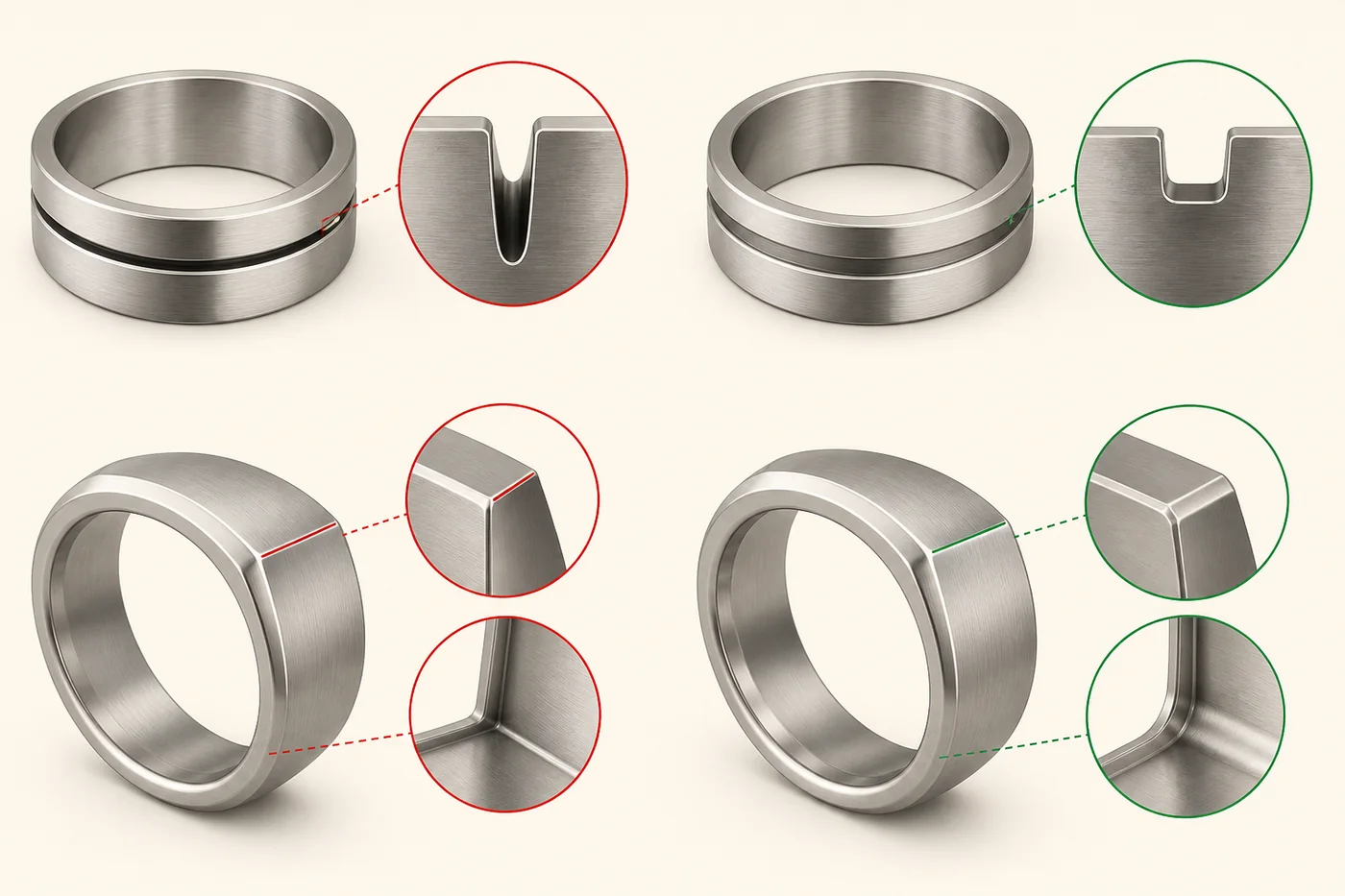
Grooves, edges and recessed areas must remain accessible to the selected finishing process; a render alone does not show every production constraint.
Engineering review

Six questions that guide the process decision

Is the profile flat or dimensional?Flat outlines may suit cutting; significant depth or compound curvature may point toward casting or forming.
Are there undercuts or closed recesses?Hidden geometry can affect mold release, forming feasibility, polishing access and assembly.
How thin are the lines and bridges?Openwork must retain enough strength after cutting, finishing and intended use.
What quantity is realistic?Tooling-heavy routes become commercially sensible at different quantities.
Which finish is required?High polish, brushing and real-gold PVD may reveal or amplify different surface conditions.
How will components connect?Welding, jump rings, clasps, settings and other components can change the preferred manufacturing route.
Cost, sampling and MOQ

Why the lowest unit price is not always the lowest project cost

What changes project cost

  • Tooling, fixtures and mold preparation
  • Material thickness and utilization
  • Number of parts, welds and assembly steps
  • Polishing access and surface requirements
  • Stone setting, color and finish options
  • Sampling rounds and approved tolerances

What to send for a useful review

  • Front, side and back views
  • Target dimensions and thickness
  • Preferred stainless steel grade and finish
  • Stone or component information
  • Expected first order and repeat volume
  • Target market, packaging and testing needs

A sample can reveal manufacturing risks, but sampling does not replace a clear production specification. Final process, MOQ, tooling, price and tolerances should be confirmed against the approved design and commercial plan.

Buyer questions

Frequently asked questions

Can every flat-looking design be made by cutting?

No. Thickness, line width, connection points, edge finishing and later forming or assembly can make another route more suitable.

Why does casting MOQ depend on the style?

Part size, geometry, mold arrangement, expected yield, finishing difficulty and other setup requirements can change the practical minimum.

Why does hydraulic pressing start at a higher MOQ?

It usually relies on dedicated forming tooling and setup. A higher, stable volume is more likely to justify that production route.

Can one design combine several processes?

Yes. A project may combine cutting, forming, welding, casting, polishing, stone setting and PVD finishing when the construction requires it.

Does real-gold PVD change the process decision?

The coating itself is a finishing stage, but the base surface, edges, recesses, welding and polishing quality must be suitable before coating. CHARMOND’s confirmed typical PVD thickness is 0.03–0.06 μm, subject to project confirmation.

Can I use an AI rendering as the production file?

An AI image is useful as a visual reference, but dimensions, construction, materials and tolerances must be translated into a manufacturable specification.

Are 100, 200–300 and 600 pieces guaranteed for every design?

No. They are confirmed process-based reference quantities. Engineers review the actual style before final MOQ is quoted.

When should I discuss testing?

Before production or shipment, once the product, destination market, finish and requested evidence are known. Testing is project-specific.

Start with the design

Not sure which process fits your jewelry idea?

Send the drawing, target dimensions, finish and estimated quantity. CHARMOND will review the geometry and discuss a practical manufacturing route before the project moves forward.